


[YOU ARE THE HOPE]Journalist at the Forefront of Climate Change Reporting in Poland Series of Reverse Interviews with the Media
![[YOU ARE THE HOPE]Journalist at the Forefront of Climate Change Reporting in Poland Series of Reverse Interviews with the Media](https://media-is-hope.org/en/wp-content/uploads/2025/03/9174D668-84DC-415D-AB0D-6A470178C11D_4_5005_c.jpeg)
Climate change is one of the most pressing issues affecting the world today. In this series of interviews with journalists from Japan and around the world, we explore the role the media should play in addressing this global challenge. This time, we spoke with climate journalist Patryk Strzałkowski, who recently received the prestigious ‘Journalist for the Planet’ award in Poland. Through his insights, we reflect on the current state of climate change reporting, the challenges it faces, and the future role of media in shaping public understanding.
Strzałkowski has been working for nearly a decade at the Polish online news outlet Gazeta.pl, where he primarily focuses on climate and environmental issues. His work spans a wide range of topics, including climate science, policy, and environmental protection. Additionally, he supports his colleagues by organizing webinars to help them better understand the nuances of climate change and incorporate this understanding into their reporting. He places particular emphasis on accurately linking extreme weather events—such as heatwaves and storms—to climate change, ensuring that readers grasp the broader context.
“I’ve actually wanted to be a journalist since before I can remember,” Strzałkowski shared. “What I love about this job is that I’m constantly learning new things and discovering different places and people. I also feel like it’s a profession where I can continually grow, as it requires me to build a broad knowledge base in areas like climate, energy markets, physics, and biology.” This passion for learning and growth has fueled his commitment to reporting on climate issues with clarity and depth.
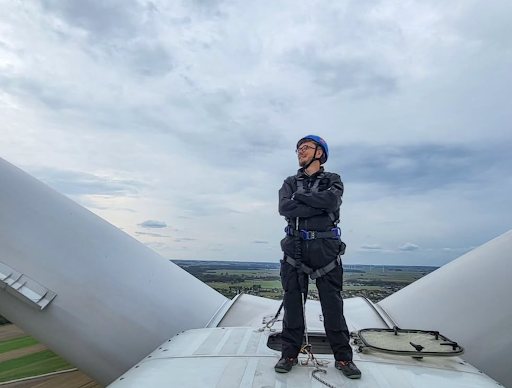
Strzałkowski explained how climate issues have become very important in the media in Poland over the last five or six years. He noted that more sections and programs are now dedicated to climate and the environment, with reporting becoming increasingly focused and intentional. “Interest in climate issues surged when the COP Summit took place in Poland in 2018,” he said. “There, we met climate experts from around the world and, at the same time, the Fridays for Future protests were starting. This made us realize that the media should do a better job at reporting the climate.” Motivated by this realization, Strzałkowski proposed a series of feature stories on climate change to be published every Friday. His editors were highly supportive, and this initiative eventually evolved into Zielona Gazeta, a dedicated section for climate and environmental reporting.
While there is less skepticism about climate change today, Strzałkowski emphasized that challenges remain, particularly with disinformation and political interference. In Poland, “there are some parties, especially to the right rightwing, who are making a big point of stopping climate action or delaying climate action. But, very often, media outlets just quote what politicians say without stating if it’s true or not,” he explained. For instance, when politicians claim that “scientists do not agree on whether climate change is real,” journalists should counter such statements with factual information, such as “97% of scientists agree that climate change is a reality.” He stressed that journalists must improve in presenting accurate, evidence-based information to combat disinformation.
Reflecting on impactful reporting, Strzałkowski mentioned an article he wrote about wind farms that received significant attention. During a parliamentary debate on wind farms, he visited a village hosting Poland’s largest wind farm and spoke to residents and the mayor. By capturing their authentic voices about the impacts and benefits of wind farms, he produced a story that resonated deeply with readers. “After all, articles that describe real experiences on the ground are the most engaging for readers,” he remarked.
However, Strzałkowski acknowledged two major challenges in reporting on climate change. The first is the complexity of terminology. “There are a lot of difficult words that we don’t use in everyday life, such as ‘greenhouse gas emissions’, for example, which can be difficult for the general public to understand,” he said. To address this, he creates short videos to distill key points and explains them in simple, conversational terms, akin to chatting with a friend. The second challenge is the financial struggle faced by Polish media outlets. With declining profits and fierce competition from platforms like Google and Facebook, generating revenue has become increasingly difficult, posing a significant obstacle to quality journalism.
Patrick’s Instagram: https://www.instagram.com/reel/DCmonfBMcqR
Despite these challenges, Strzałkowski sees the media’s role in solving climate change as indispensable. “In a democracy, politicians’ actions are influenced by public concerns and voices. Therefore, it is crucial for the media to report accurately on climate and energy policies,” he explained. Moreover, the media must hold politicians accountable by scrutinizing their statements and promises, ensuring their responsibilities are clear. Even with the rise of social media, traditional media remain essential for their expertise and investigative capabilities, which enable in-depth coverage of complex topics.
In closing, Strzałkowski offered a message to journalists in Japan: “American journalist *Mark Hertsgaard once said, ‘In the future, all journalists will be climate journalists.’ Whether you write about the economy, security, or even fashion, all of these things are related to climate in one way or another. In many ways, climate change can affect businesses, and our consumer choices can affect the environment and climate change. Climate change affects everyone and will affect everyone’s lives in the future.”
*Mark Hertsgaard:
Co-founder of “Covering Climate Now (CCNow),” a climate change reporting network with more than 500 media outlets in 60 countries around the world. Recipient of ” Hall of Fame” award in the Media is Hope AWARD, which honors media that contribute to climate change solutions.
◼︎”Media is Hope AWARD ‘Hall of Fame’ -4 journalists from Japan and abroad, including CCNow’s Mark Hertsgaard, receive the award“
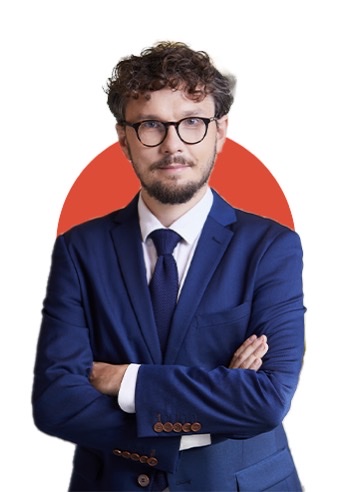
Patryk Strzałkowski – Journalist at Gazeta.pl since 2015. Head of the Green Desk and the Zielona.Gazeta.pl website. Specialises in climate and environmental issues and international topics. Author of the series Fridays for Climate, reportages from the Middle East and other parts of the world. Host in the programme Poranna rozmowa Gazeta.pl (formerly Zielony Poranek). Graduate of journalism at Adam Mickiewicz University in Poznań and the Polish School of Reportage. Member of the Oxford Climate Journalism Network. Winner of the ‘Journalist for the Planet’ award, awarded as part of Radio ZET’s Andrzej Woyciechowski Prize in 2023.